
On this page
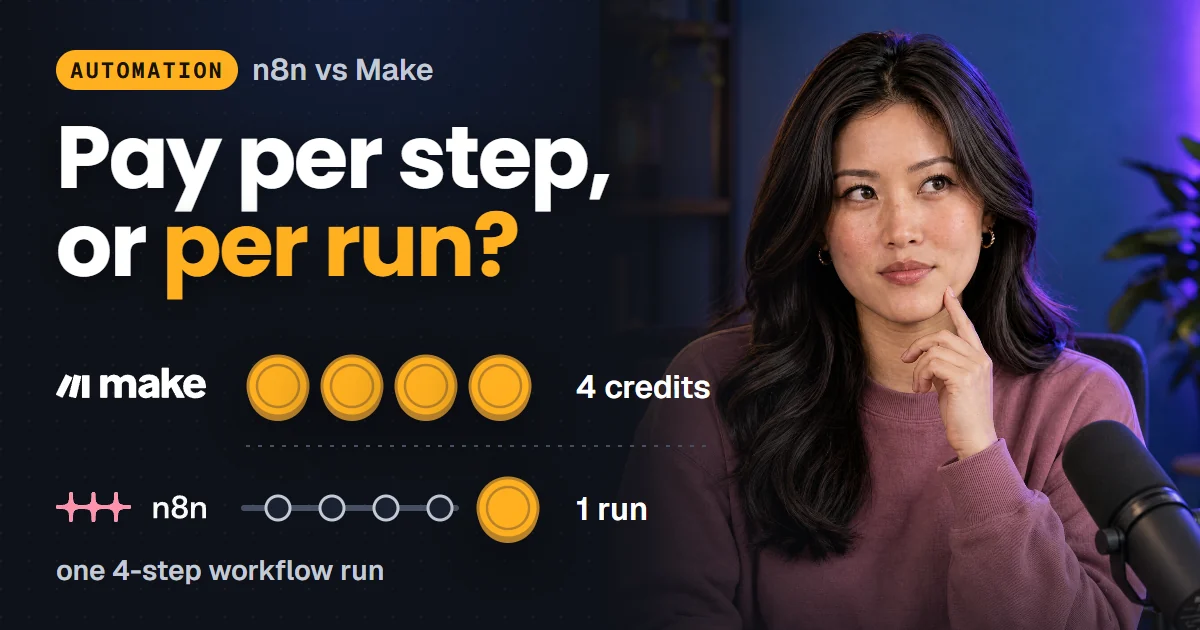
Short answer: Make is the easier start: it has a free plan with 1,000 credits a month [2], and most actions use 1 credit. n8n charges per full workflow run instead of per step, starting at 2,500 executions a month on its Starter plan [1], and you can self-host its Community Edition for free. If your workflows are long or you want AI agents with code steps, n8n usually works out cheaper per run. If they are short and you don't want to manage a server, Make is simpler.
Quick verdict
For a small online store that needs a few automations (new order to a sheet, a welcome email, a Slack alert), Make's free plan may be enough to start, and you never touch a server [2]. Pick n8n when a single workflow has many steps, when you want to run AI agents and MCP tools, or when you'd rather host it yourself [1]. Our earlier Make vs Zapier vs n8n free plan guide covers the free tiers in more detail.
Billing units: executions vs credits
This is the biggest difference. Make has billed in credits since August 27: each action a scenario performs uses credits, most actions use 1, and some AI features use more [2]. Router and error-handler modules use none. A single run can use anywhere from two credits to thousands, depending on the steps [2].
n8n bills per execution, which is one run of a whole workflow, however many steps it has or however much data it moves [1]. A workflow on a daily schedule is about 30 executions a month; one that runs every 5 minutes is about 8,600 to 8,900 [1].
So a 10-step workflow that runs 1,000 times a month is about 10,000 credits on Make (if each step is a standard 1-credit action) and 1,000 executions on n8n.
Pricing side by side
Prices in USD from each official pricing page, checked Oct 19, 2026. n8n picks the currency for you, so its yearly prices are approximate. Make prices are at its default 10,000 credits a month and go up as you move the credits slider.
| Plan | Billed monthly | Billed yearly | Monthly allowance |
|---|---|---|---|
| Make Free | $0 | $0 | 1,000 credits [2] |
| Make Core | $16/mo | $12/mo | 10,000 credits (default; price scales with credits) [2] |
| Make Pro | $28/mo | $21/mo | 10,000 credits (default; price scales with credits) [2] |
| Make Teams | $51/mo | $38/mo | 10,000 credits (default; price scales with credits) [2] |
| n8n Starter (Cloud) | $24/mo [1] | About $20/mo (20€/mo on the official page) [1] | 2,500 executions [1] |
| n8n Pro (Cloud) | $60/mo [1] | About $50/mo (50€/mo on the official page) [1] | 10,000 executions [1] |
| n8n Business (self-hosted only) | $960/mo [1] | About $800/mo (667€/mo on the official page) [1] | 40,000 executions [1] |
| n8n Community Edition | Free | Free | Self-hosted, no plan limit listed [1] |
n8n says yearly billing saves 17% [1]. All n8n plans include unlimited users, unlimited workflows and every integration [1]. The Cloud free trial gives 1,000 executions with no credit card; only the Business trial (14 days) asks for a card [1]. Make credits expire at the end of the term, and you can buy extra credits in bundles of 1,000 or 10,000 [2]. If Make runs out, scenarios stop until you add credits; on n8n Business, workflows keep running and overage may be billed [2] [1].
Other n8n limits: Starter allows 5 concurrent executions and 5-minute maximum run time; Pro allows 20 or 50 concurrent executions and 40 minutes [1]. Cloud data is stored in Frankfurt, Germany [1].
Cost for three store workflows
These are worked examples, not quotes. Real credit use depends on your modules.
- Shopify order to Google Sheet (3 steps, 300 orders a month): about 900 credits on Make, inside the free plan's 1,000, so $0; 300 executions on n8n, inside Starter.
- Order to sheet, email and Slack (6 steps, 1,000 orders): about 6,000 credits on Make, beyond the free plan but inside Core ($16 a month, or $12 billed yearly); 1,000 executions on n8n Starter ($24 a month, or about $20 billed yearly).
- Hourly inventory sync (8 steps, about 730 runs): about 5,840 credits on Make, inside Core; about 730 executions on n8n, inside Starter.
For our Shopify scenarios on Make, see Make.com Shopify integration: 7 automations.
Self-hosting n8n: what it costs
The Community Edition is free to download from GitHub [1]. You still pay for a server and spend time on updates, backups and security, and n8n's pricing page doesn't list those costs. The Business plan is self-hosted only: you get a license key that pings n8n's server daily and reports production execution counts [1]. On self-hosted n8n, the Assistant uses your own AI key, so no credit limits apply [1]. Make is cloud-only; its on-prem agent connects to local systems but isn't self-hosting [2].
AI agent features
Every n8n plan includes agents, MCP and AI nodes, and Starter adds 1,600 Assistant credits a month and AI models without API keys [1]. Its plans also list an MCP Server Trigger, an MCP Client and human approval for tool calls [1]. On Make, some AI features that use Make's AI Provider consume more than 1 credit per action [2], so AI-heavy scenarios can use credits faster.
Ease of use and integrations
Make says it has more than 1,000 standard app integrations, plus custom apps for any public API [2]. n8n includes all of its integrations on every plan, plus JavaScript and Python code steps and custom HTTP requests [1]. Make suits people who don't code. n8n rewards some technical comfort; its own pages describe it as built for technical teams [1].
When Zapier still wins
If you need the widest app catalog and the least setup, Zapier may still fit better. We compare its prices with Make in Make vs Zapier pricing.
Who should pick n8n
Choose n8n if: your workflows have many steps, since n8n counts one execution per full run, or you want AI agents, code steps or self-hosting [1].Think twice if: you don't want to manage a server or pay from the start, because n8n Cloud has a free trial but no free plan, and Starter is $24 a month [1].
Who should pick Make
Choose Make if: you run a few short store automations and want a free plan and a visual builder with nothing to host [2].Think twice if: your scenarios have many steps or use AI features heavily, since each action uses credits and scenarios stop when credits run out [2].
If you pick Make, our Make.com tutorial for beginners walks through your first scenario.
FAQ
Is n8n cheaper than Make?
Per run, often yes for long workflows, because n8n counts one execution per run while Make counts credits per action [1] [2]. For a few short workflows, Make's free plan costs nothing.
Is self-hosted n8n really free?
The software is free [1]. Hosting, maintenance and your time are not.
Does n8n have a free plan?
n8n Cloud has a free trial with 1,000 executions, not a permanent free plan [1]. The free option is the self-hosted Community Edition.
Which is better for AI agents?
n8n lists agents, MCP and AI nodes on every plan [1]. Make can run AI steps, but some use extra credits [2].
Bottom line
Either tool saves time only if the workflow fits your store; neither guarantees more sales. Start with Make's free plan for simple automations, or try n8n Cloud if your workflows are long. If Pabbly Connect is on your shortlist too, see Pabbly Connect vs Make vs Zapier.
We earn a commission on Make links. n8n links on this page are plain links.
Sources
- n8n pricing page, checked 2026-10-19
- Make pricing page (FAQ), checked 2026-10-19